

An Overview of Metal Industry Wastewater Treatment
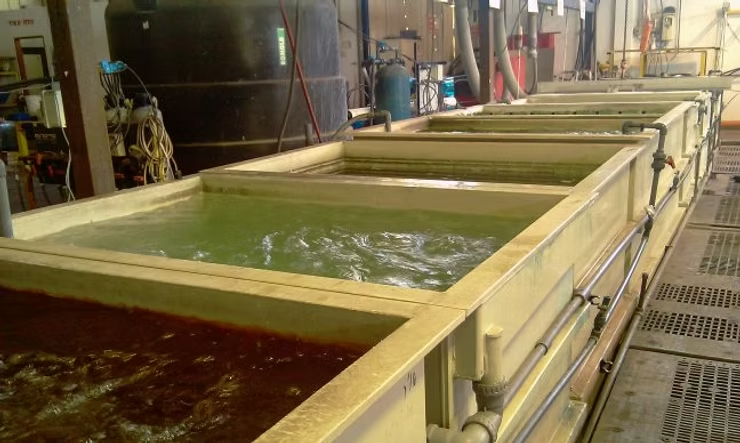
Metal industry wastewater has particularly high toxicity potential due to the presence of heavy metals and toxic organic substances, making treatment essential. We have prepared a brief overview on the subject.
The metal plating industry is widespread globally on a large scale, ranging from plating electronic components to automotive parts. This is possible due to various processes that allow us to achieve different properties depending on the metal used, such as: corrosion resistance, wear resistance, aesthetics, etc.
There is a wide range of different metal plating processes, each with different by-products, but in most cases, we must deal with two main pollutants: Chromium and Cyanide. Both have severe health implications and are included in the list of substances prohibited from discharge into sewage infrastructure (in accordance with the Water and Sewage Corporations Law - Industrial Wastewater Discharged into the Sewage System, 2014).
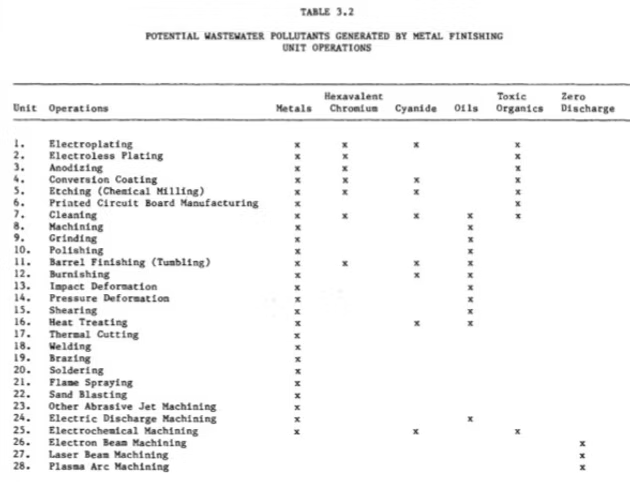 Table presenting potential pollutants by process type
The standard working method for metal industry wastewater is stream segregation based on the type of pollutants. This is due to the inherent conflict between the two central substances—Cyanide and Chromium—as the treatment for each requires different conditions that are mutually exclusive.
Cyanide:
Cyanide is a molecule composed of carbon and nitrogen (CN) which has the ability to create complexation of the metal intended for plating onto the surface. Cyanide acts as a suspending agent, thereby enabling the crystallization of the metal onto the surface. Cyanide must be kept in a stream segregated from acids, due to the fact that in the presence of acid, cyanide will react to form hydrocyanic acid (HCN), commonly known as Zyklon B. Furthermore, cyanide is a toxic molecule to all living organisms; therefore, the restriction on its discharge into the sewage is severe, and it is defined as a prohibited substance (0.5 mg/L).
Cyanide treatment is performed via a two-stage oxidation process: from cyanide to cyanate, and from cyanate to carbon dioxide and nitrogen gas.
As mentioned, the pH value is a central issue at this stage, and neutral pH levels must be maintained.
Cyanide oxidation can be performed using various oxidants; typically, alkaline chlorine (e.g., hypochlorite salts) is used due to its efficient oxidation capacity and attractive price. The oxidation process requires sufficient retention time to allow all cyanide to react.
Cyanide oxidation reactions:
I - CN + 2OH- ---> CNO + H2O
II - 2CNO + 4OH- ---> 2CO2 + N2 + 2H2O
Chromium:
Chromate (chromium ion in oxidation state +6) is a primary component in the metal industry thanks to its properties: aesthetics, surface strength, wear resistance, and corrosion protection for iron. Chromium is often used in all plating methods as a primary layer (primer), which allows better adhesion of another metal onto the base surface.
Chromate is extremely toxic and has carcinogenic effects; therefore, the discharge restriction into the sewage is very high (0.1 mg/L).
Chromium must be reduced in an acidic environment (which is the primary reason for segregating streams between Chromium and Cyanide),
at values between 3-3.5 pH.
The common reducing agents are Ferrous Sulfate (FeSO4) or Sodium Bisulfite (NaHSO3), though they leave components behind and require sulfur treatment.
After the reduction of chromate to chromium ions +3, the chromium can be precipitated in an alkaline environment (pH 10), thereby reaching the desired values according to sewage system discharge regulations.
Heavy Metals:
A name for a group of metal ions that affect human and animal health. These metals will usually be the metals plated onto the base surfaces, such as: Nickel, Cadmium, and Gold.
Nickel – A silver-colored, corrosion-resistant metal. Because of its corrosion resistance, Nickel is primarily used for plating metals to prevent corrosion. Nickel is popular in the aerospace industry because of the composite alloys made from it, which are used primarily for jet engines. It is used to produce stainless steel and other corrosion-resistant alloys. Minimal exposure to nickel must be ensured because even extremely small amounts of nickel can be toxic. Nickel dust can be easily inhaled, and nickel is known to be carcinogenic. Skin exposure to nickel causes dermatitis. Nickel is included in the list of substances prohibited by all water and sewage corporations for release into sanitary infrastructure—up to a level of 0.5 mg/L.
Cadmium – A soft, malleable metal commonly used in batteries, alloys, solar cells, and plastic stabilizers (especially in deposition plating). Cadmium is corrosion-resistant and, like Nickel, can serve as a protective layer on other metal surfaces.
Cadmium is an extremely toxic metal, and exposure to it is known to be carcinogenic and specifically damages the heart, blood, kidneys, digestive, and neurological systems.
In dust form, cadmium can burn and release toxic fumes into the environment.
Cadmium is included in the list of substances prohibited by all water and sewage corporations for emission into sanitary infrastructure—up to a level of 0.1 mg/L.
We aim to remove all heavy metals in the process through precipitation in an alkaline environment, thereby lowering the concentration of metals in the water to the desired value according to regulations.
Additionally, it is recommended to perform a coagulation and flocculation process after precipitate formation to enhance the settling capacity of the mixed liquid, enabling better removal of pollutants. If necessary, we perform sludge dewatering to reduce the volume of sludge sent to landfilling.