

Industrial Wastewater Treatment
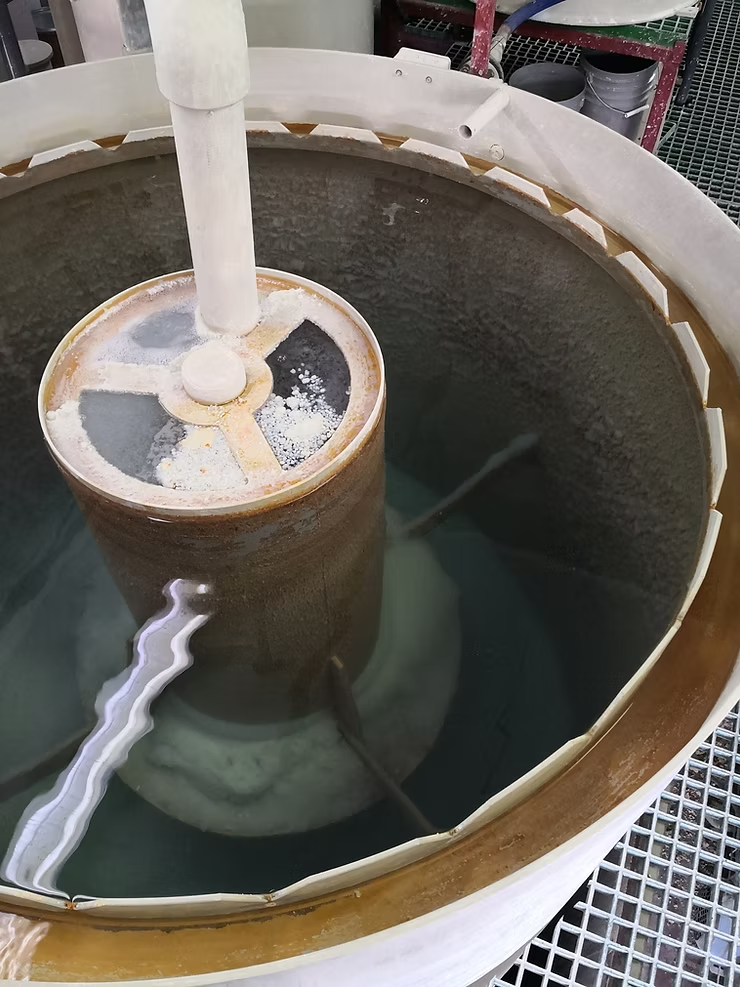
With technological developments, population growth, and the increase in life expectancy and quality of life, many issues are arising at a similar pace.
Population growth leads to an increase in wastewater and sewage flowing through piping; more products generate more waste, and as part of the rising quality of life, authorities are required to provide immediate solutions. The challenge of managing wastewater has accompanied humanity for centuries, gaining momentum in the 19th century when domestic sewage became a source of disease and epidemics in urban areas, and agricultural and industrial effluents caused the pollution of groundwater and rivers, damaging man's most important natural resource.
In the State of Israel, the field of wastewater was regulated in 2014 with the establishment of regulations for the discharge of industrial effluents into the sewage system. These regulations set clear metrics for quantities and concentrations of various parameters such as sodium, organic matter, heavy metals, and more. These standards are enforced by water and drainage authorities, and violations can range from minor fines to the suspension of operations (depending on the severity of the deviation). In Israel, there is high sensitivity to this because most sewage passing through municipal Wastewater Treatment Plants (WWTP) is used for agriculture as part of Israel's complex water regime. The beauty is that the same water, when treated correctly and professionally, even contributes to crop yields due to high nutrient content (all this in a separate article).
With the tightening of regulation and control over industry regarding their waste treatment and discharge methods, a high demand has emerged for experts in the field who know how to assist factories in treating wastewater in the best possible way to prevent fines and operational shutdowns.
Wastewater treatment usually goes hand-in-hand with the world of water, since effluents and waste are discharged through drainage and sewage systems, and most professionals in the field specialize in the chemistry and physics of water.
The range of substances to which the standard applies is wide, and we will note the main ones: Organic matter - primarily found in municipal WWTPs, slaughterhouses, food factories, and agriculture. The optimal treatment for these is through the biological decomposition by bacteria and fungi. This treatment requires monitoring and proper cultivation of biological populations sensitive to temperature, pH, oxidation conditions, nutrients, and more. The process requires treating emitted gases and can also produce natural gas.
Organic matter is primarily measured by COD and BOD parameters, which are indicators of the material's biodegradability.
Improper treatment of organic matter can be a source of diseases and pathogens in the areas where it is discharged and may also contain toxic substances such as phenols.
Heavy metals - characteristic of heavy industries, containing highly toxic substances such as aluminum, mercury, chromium, etc.
These materials are extremely toxic, mobile, and lethal even in small concentrations. Their treatment is highly essential, and enforcement in this field is strict. The optimal treatment for metals is through controlling pH values and redox (reduction-oxidation) levels. Generally, metals precipitate and become immobile when pH is high and conditions are oxidative. Therefore, through simple treatment involving chemical dosing, metals can be separated from the liquid medium and removed prior to discharge into the sewage system.
Treatment Methods
Wastewater treatment facilities are diverse and, as mentioned, can be biological, chemical, or physical.
The most common facility is the DAF (Dissolved Air Flotation) system and the Pipe Flocculator. After preliminary filtration, the wastewater enters a long, winding pipe and undergoes chemical treatment (coagulation and flocculation) that causes particles to adhere to each other and form flocs. It then flows to the DAF unit where, while injecting water saturated with air, the flocs float to the top, are scraped off and removed, while the clean water flows to the sewer. This principle can also be applied through sedimentation, where materials are settled and removed from the bottom, depending mainly on the nature of the waste; waste containing many fats, such as food or soaps, is much easier to float.
There are many traditional and advanced methods for wastewater treatment, each with its own advantages.
The method of treatment must be determined according to the factory's facilities, waste composition, and the resources the factory can invest.
Factory managers often struggle with wastewater treatment for many reasons: lack of attention due to multiple tasks, lack of knowledge and understanding of standards, lack of familiarity with technology, lack of employee skill, and more.
Environmental consulting firms know how to provide solutions to these problems. When arriving for an initial survey at a factory, they collect data regarding the plant and the wastewater it produces:
- Nature of the wastewater - metals, fats, organic matter, cyanide, phosphorus.
- Common deviations - sodium deviations, chlorine deviations, high turbidity, odor.
- WWTP operating expenses.
- Facility operator skills.
- Factory resources.
After collecting the parameters, the company will be able to formulate a status report and tailor the best, most cost-effective, and greenest wastewater treatment solution for the factory.
For example, at Greenfield Eco, we arrived at a long-standing factory with recurring deviations in sodium, chlorides, and chromium. We formulated a status report based on the parameters. The facility was old and neglected, the operating costs for chromium sedimentation were expensive, and the facility workers were helpless regarding its operation.
A proposal was submitted where the facility underwent an upgrade and reconstruction by the company's engineers. The chromium treatment unit was isolated so that its treatment would be focused and inexpensive. The treatment method was adapted to the specific deviations and characteristic wastewater, unlike the general treatment used previously. Furthermore, the employees received training and close monitoring by the company's control room staff.
Conclusion
Wastewater treatment is an issue of utmost importance in the modern era. This issue is not expected to disappear but only to grow with technological advancement. Many factories realize that it is no longer possible to turn a blind eye, as the economic and environmental damage often outweighs the benefits. Nevertheless, the technologies and knowledge for wastewater treatment exist and are accessible, making the issue a routine matter when applying the right effort toward a correct and customized facility.