

Sludge Dewatering Unit
 Source: Wikimedia
Many facilities perform the separation of pollutants from water. The products of this separation process are sludge containing the pollutants and a clarified effluent. In this article, we will primarily discuss sludge.
Sludge must be treated or disposed of, and the more water it contains, the larger the volume of sludge that must be handled. Therefore, there are many ways to dewater the sludge so that it contains as little water as possible. In this article, we will discuss methods for sludge dewatering.
In sedimentation processes, DAF (Dissolved Air Flotation), biological processes, and similar treatments, we receive sludge with 2-12% solids. This means that in most cases, the sludge will contain over 90% water! Sludge dewatering will significantly reduce sludge treatment costs for the simple reason that the sludge will have a smaller volume after pressing and water removal.
Each type of sludge is suited to a different dewatering unit, and one must examine the sludge and choose the correct equipment. Selecting an unsuitable unit will result in poor dewatering at best.
It is important to note that in all the units mentioned in this article, if there is no successful physico-chemical process prior to feeding, the dewatering system's operation will be inefficient and the mechanical integrity of the system may even be compromised.
The first method we will mention is the simplest and most reliable, and as such, it is very common among industrial manufacturers and wastewater treatment plants – the Filter Press.
 Filter Press
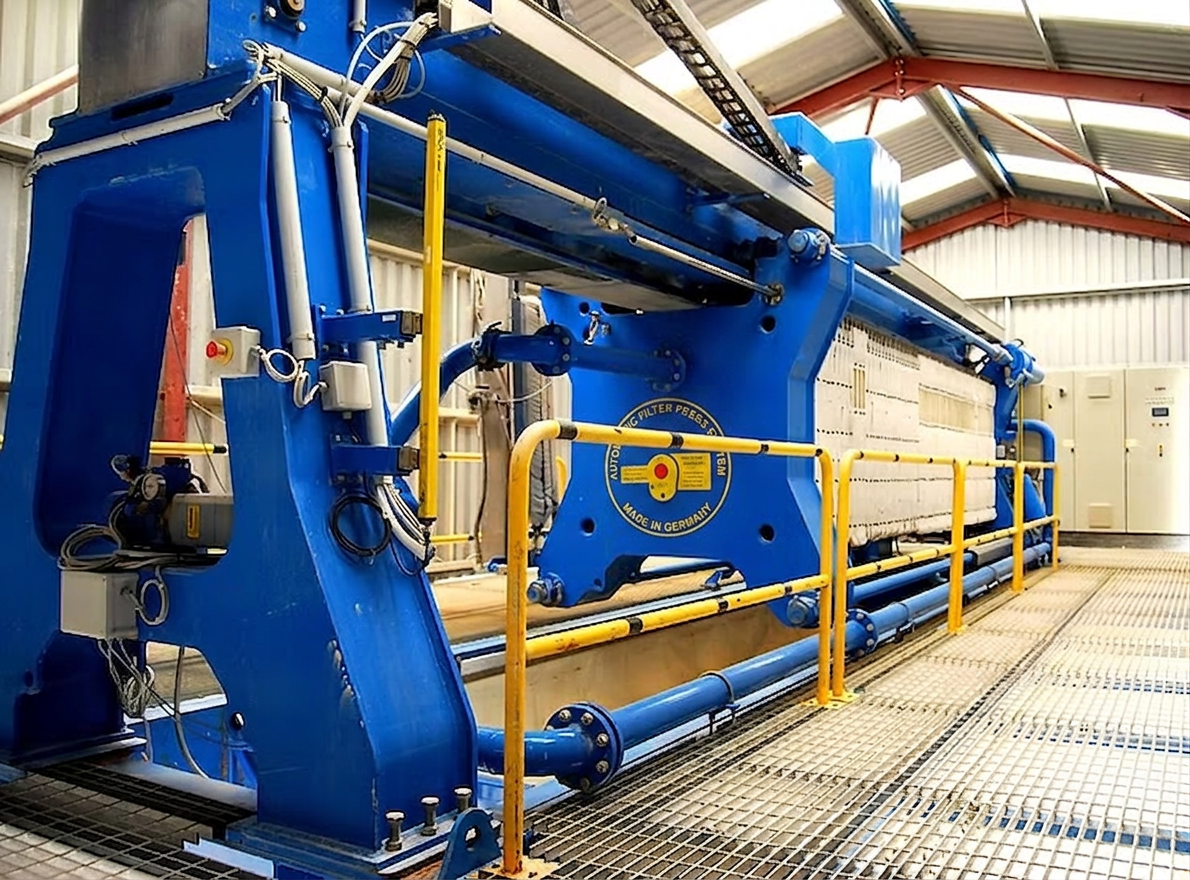
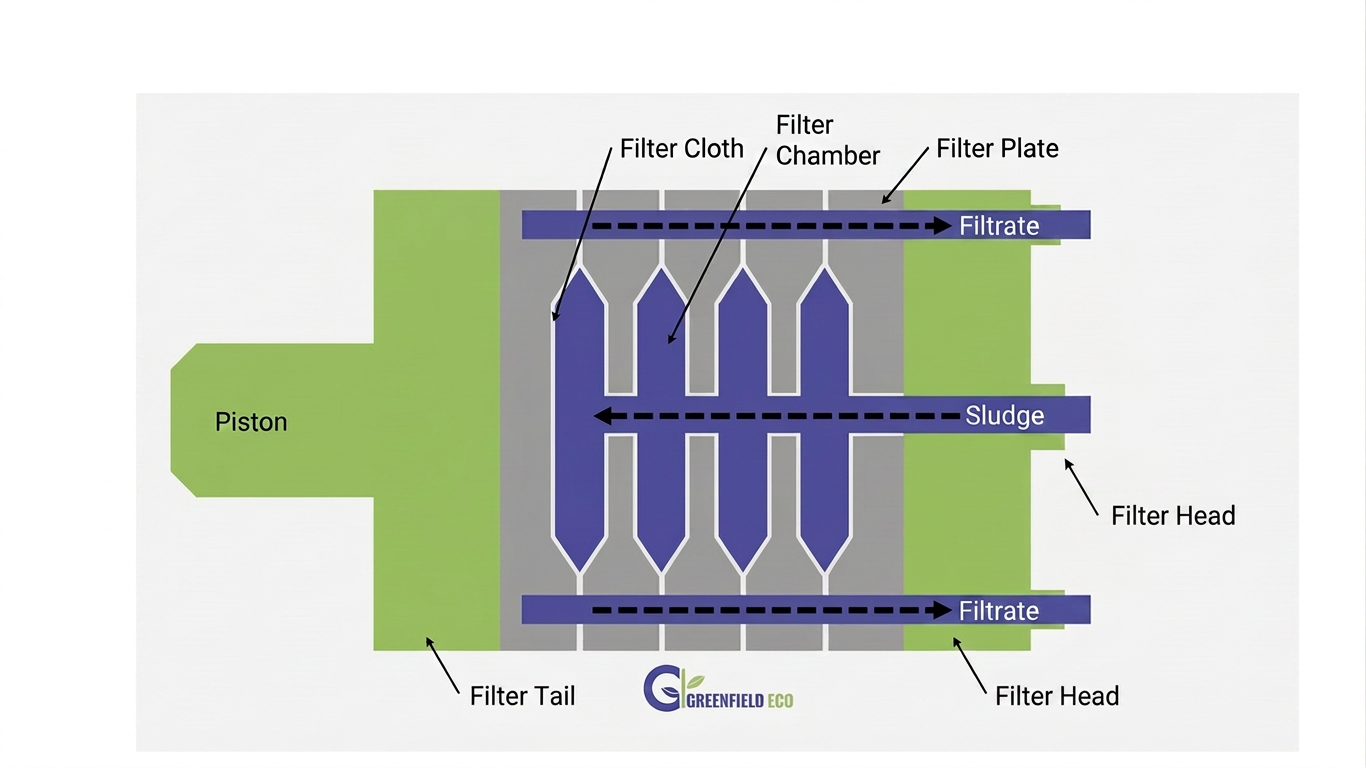
A filter press is a unit consisting of plates pressed together by hydraulic force. A common mistake is thinking that the hydraulic system is what squeezes the sludge, but in practice, in most systems, the sole role of the hydraulic system is to clamp the filter press plates together. A filter cloth is placed on each plate, and there is a hole in the center of each plate. The sludge is fed into the filter using a high-pressure pump. The sludge flows between the plates and fills the chambers. The filtrate – the liquids or water – flows out through the cloths and the drainage ports out of the filter. The sludge cannot pass through the cloth and remains trapped between the plates.
Once the filter is closed using the hydraulic system, the filter's volume does not change. What does change is the amount of sludge that continues to enter the filter via the pump, so more and more liquid exits while the sludge stays in the chambers. Once the filter is full and no more sludge can be introduced, the hydraulic cylinder moves the plates away from each other, and all the sludge falls down into a sludge collection bin. While there are fully automatic models, in many cases, an operator is required to help the sludge cake fall from the filter chambers into the collection bin. There are various methods for removing sludge from the filter if it does not fall on its own, depending on the unit model and the nature of the sludge.
Another type of dewatering unit is the Centrifuge.
Decanter Centrifuge
 Decanter Centrifuge
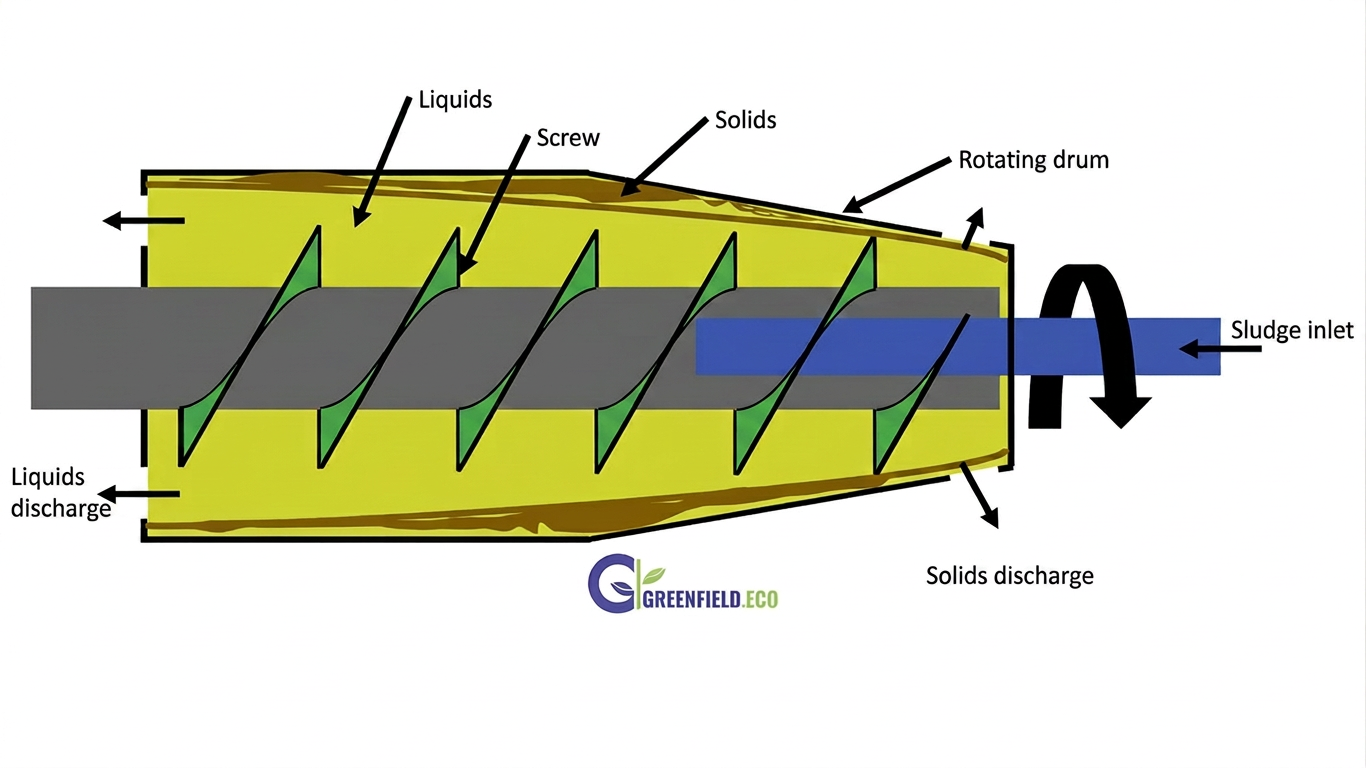
The decanter is a horizontal conical drum with a slight slope. It rotates very fast, reaching forces of 4000-5000G. The sludge is fed into the filtration drum, and due to the strong centrifugal force, the sludge coats the inner walls of the drum. Because of the conical shape, the liquid flows toward the wide end of the cone and is discharged, while on the other side, the solids remain clung to the drum itself and must be removed separately. To perform this separation, an internal screw conveyor (auger) rotating at a different speed is installed to scrape the sludge to the side, from where it exits the drum.
Vertical Basket Centrifuge (Inverted Drum)
Imagine an inverted drum that is closed at its top and rotates at high speed. The un-dewatered sludge is introduced into the drum. The sludge remains stuck to the inner walls of the drum while the liquids flow downward. After some time, the drum stops, and blades scrape the sludge, causing it to fall downward. Unlike the decanter system which operates as a continuous system, the vertical basket centrifuge, while automatic, is not continuous (it operates in batches). In most cases, a drum centrifuge can achieve a higher solids concentration, but since it is not a continuous system, its flow capacity is lower than a decanter of identical size.
In summary, let's compare the three filters: Filter Press, Decanter Centrifuge, and Vertical Basket Centrifuge. Generally, a filter press will provide the highest sludge cake solids concentration, but it usually requires manual intervention by an operator for cake discharge. A decanter centrifuge allows for higher flow rates, but the solids concentration will be approximately 40% lower than a filter press. A vertical basket centrifuge serves as an intermediate solution, allowing for automatic discharge, but the solids concentration is about 20% lower than that of a filter press.